TESS planet candidate · independent vetting · November 2026
TIC 219329329.01
A Jupiter-size object crosses a Sun-like star 1,800 light-years away every 3.48 days. It passes every false-positive test run so far. Its mass has not been measured, so it is a candidate, not a confirmed planet.
Likely planet · not validated
Star and candidate to scale. The crossing is close to the star's edge, which makes the dip V-shaped.
Orbital period
3.4816 days
known to ±0.3 seconds
Transit depth
0.97%
of the star's light, for 2.1 hours
Radius
1.24 RJup
± 0.07
False-positive probability
≈ 6%
validation needs under 1.5%
Mass
< 87 MJup
3σ upper limit, not a measurement
The evidence at a glance
Fifteen pieces of evidence, each with its own link, data files and analysis script. All of it comes from public TESS full-frame images (sectors 68, 95, 102, 103, 104 and 105) and the Gaia DR3 catalogue.
What would confirm it. A planet, a brown dwarf and the smallest stars are all about this size. Only a mass from radial-velocity spectra can tell them apart: a planet would move the star by about 126 m/s per Jupiter mass, a brown dwarf or small star by several km/s.
The signal
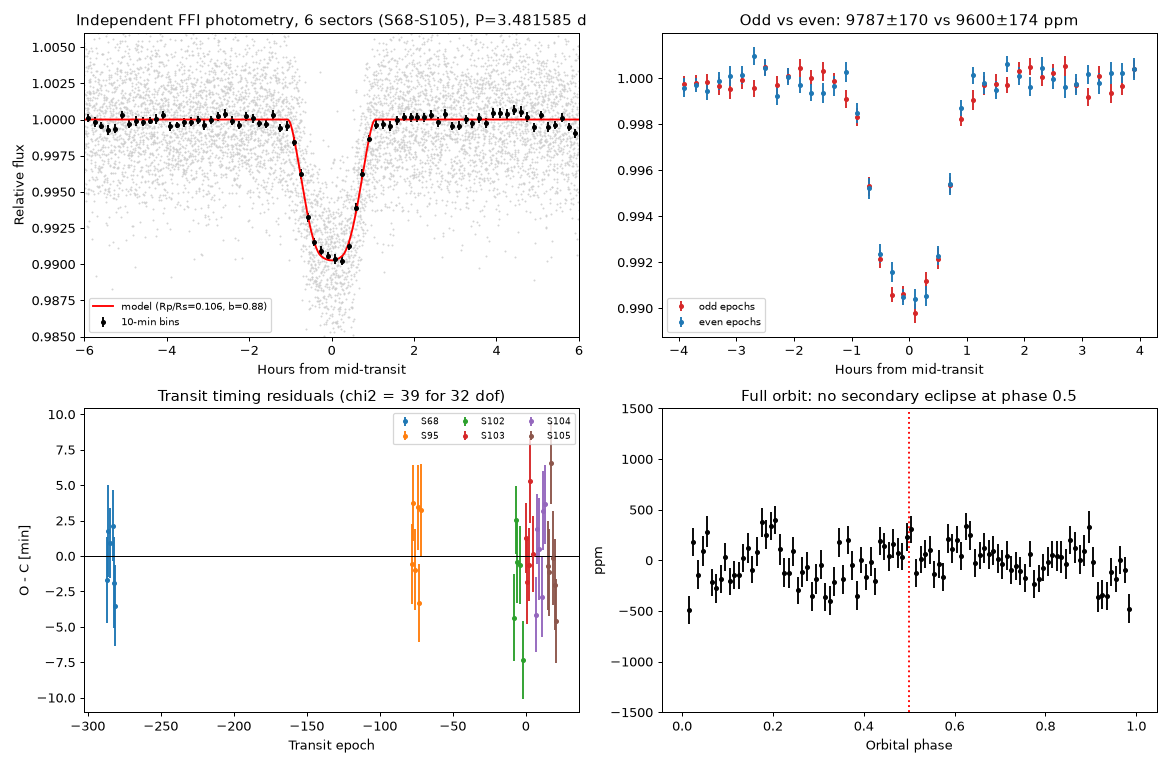
The star dims by about 1% for two hours, every 3.4816 days, in every sector TESS has observed it.
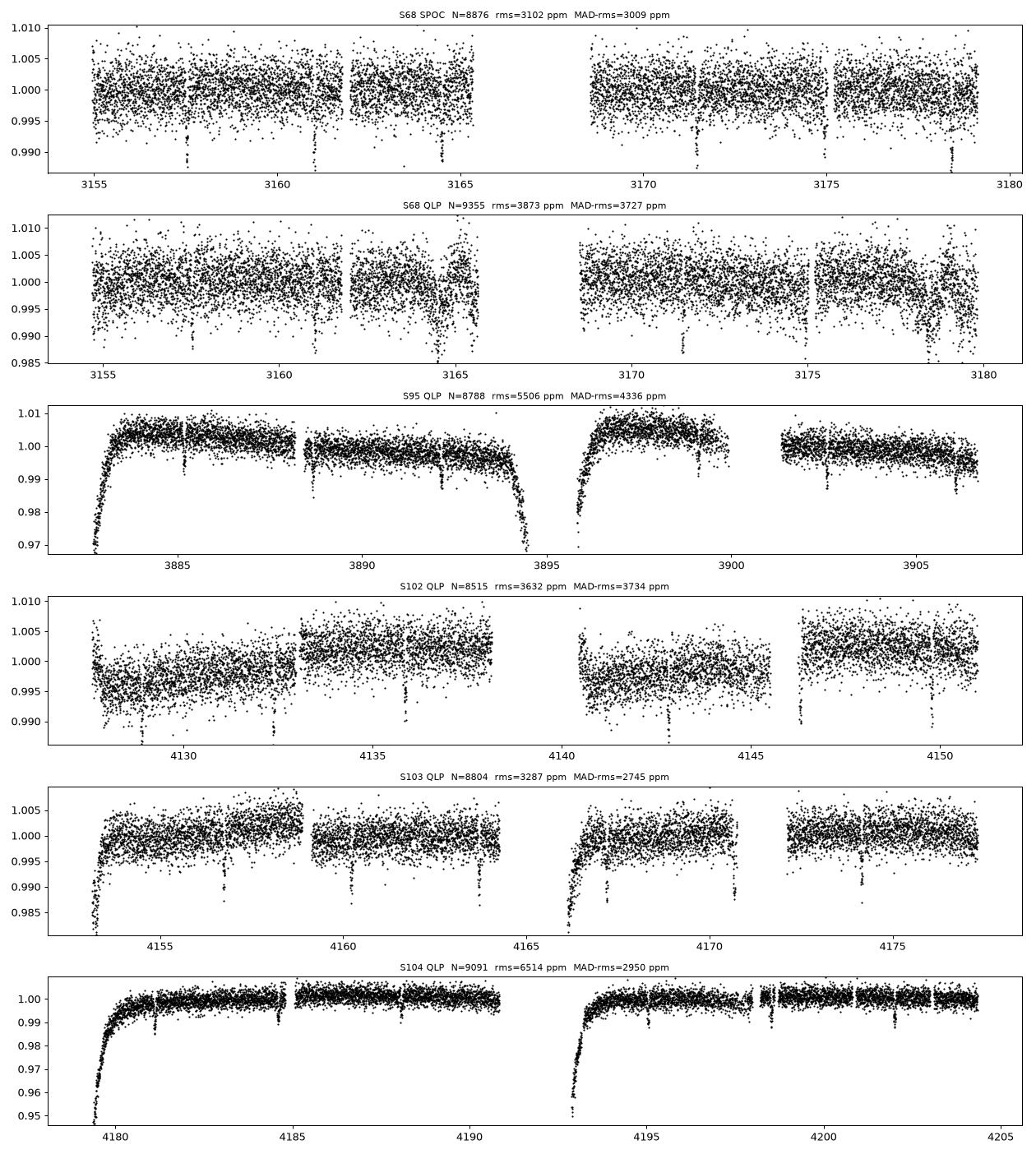
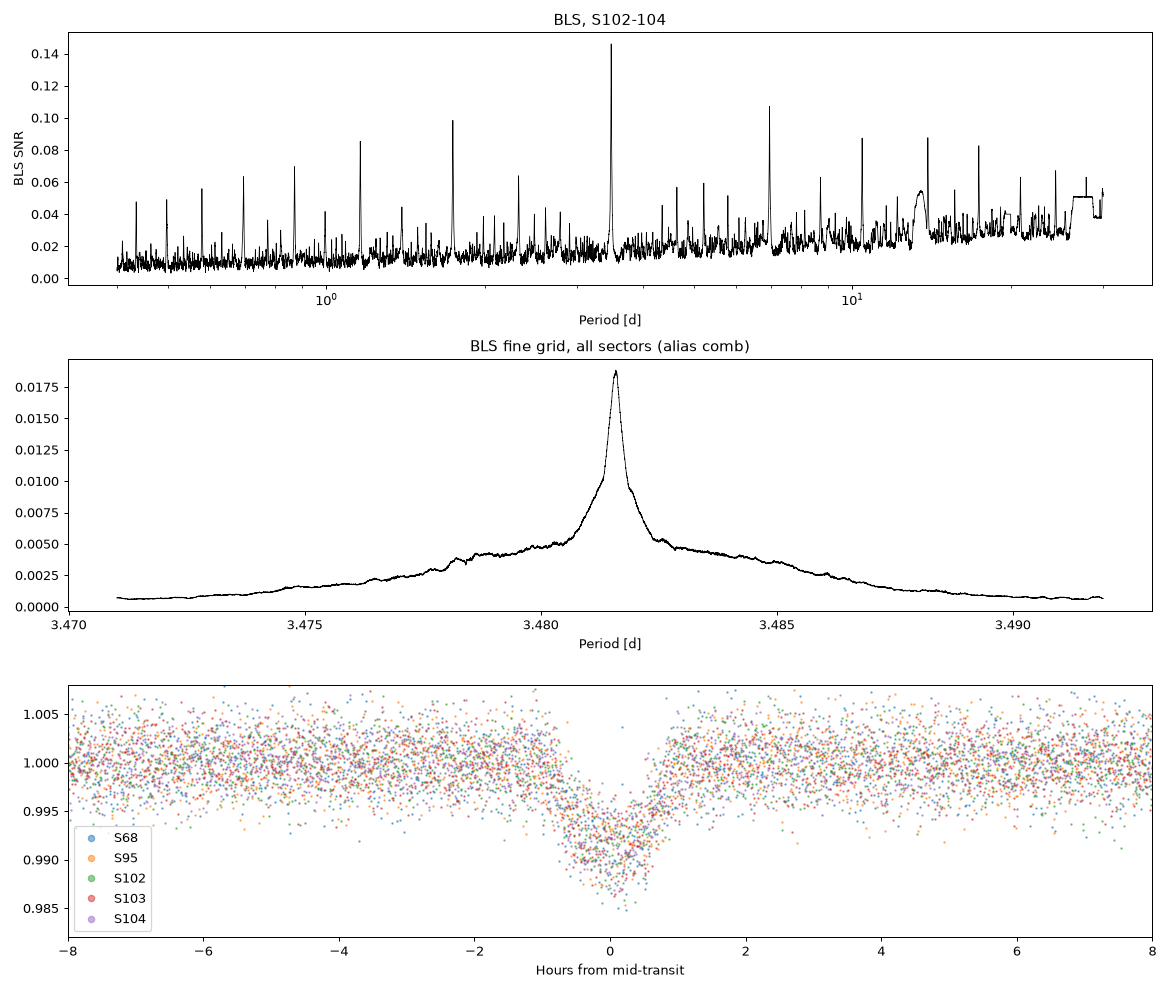
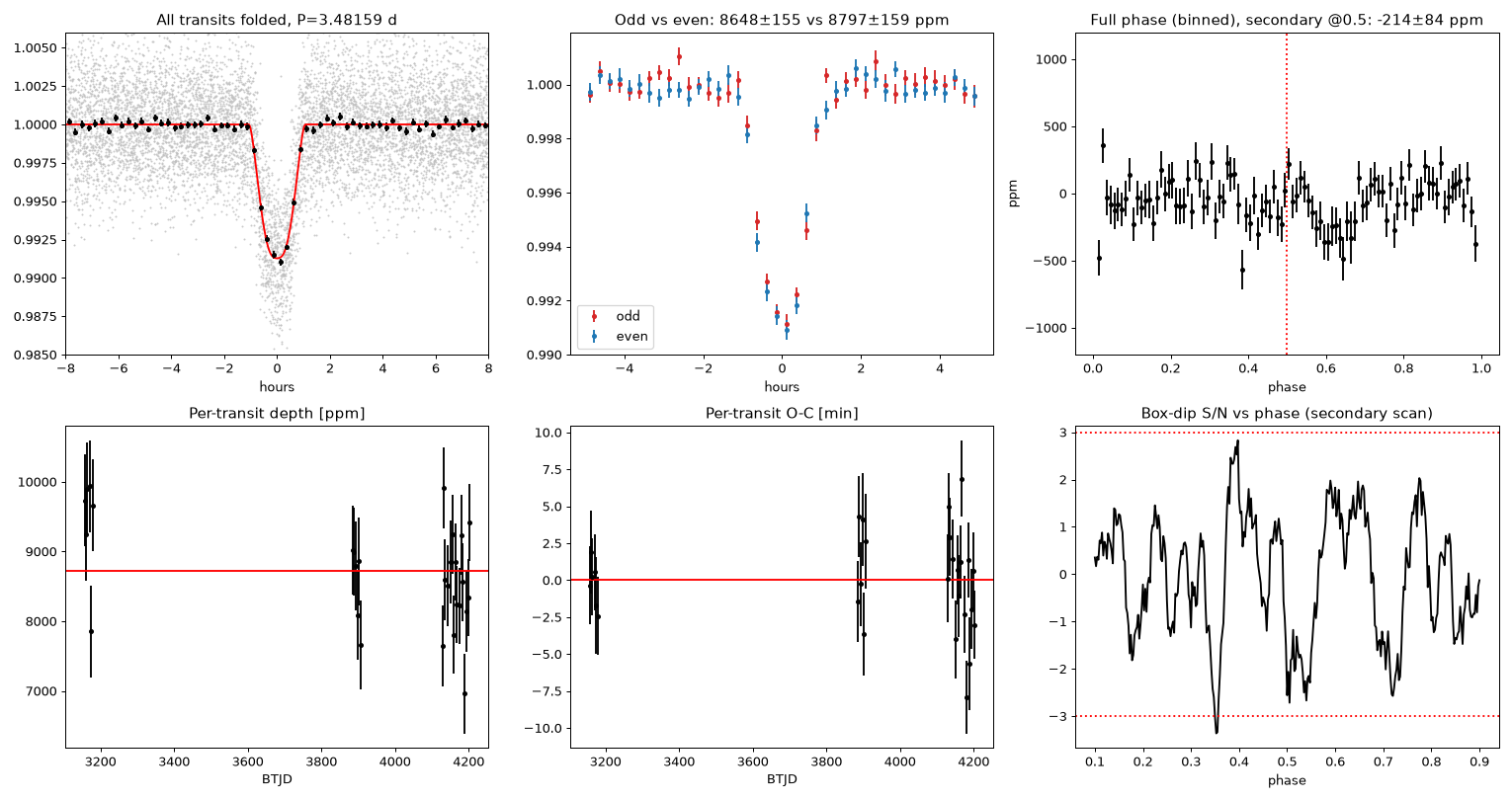
51,810 brightness measurements from six sectors, stacked on the 3.4816-day period. The dip is 0.97% deep and lasts 2.09 ± 0.05 hours.
The fitted model is a planet-size body crossing near the edge of the star (impact parameter 0.87 ± 0.02), which is why the dip has sloping sides and a short flat bottom.
Blue points are 10-minute averages with their uncertainties; grey dots are a sample of individual 200-second measurements. Photometry is my own 3×3 pixel aperture on the full-frame images.
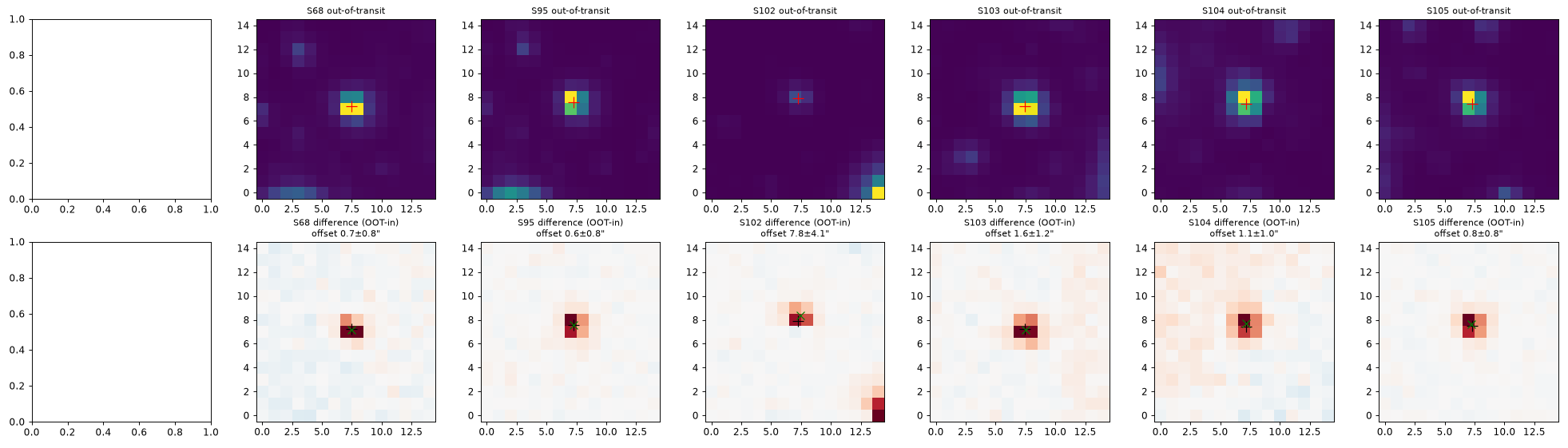
Subtracting in-transit images from out-of-transit images leaves a single point of lost light, on the target. Its centre is within about 1″ of the star in five of six sectors.
Sector 102 is 7.8 ± 4.1″ off (1.9σ). There the wing of a bright star 263″ away crosses the corner of the image; its own "dip" is a single event, not periodic.
Light (left) and light lost in transit (right)Light gained in transitCatalogue position of the targetCentre of the lost light
Gaia DR3 lists no star within 22″. The nearest is about 1,400 times fainter in the TESS band and adds 0.07% to the target's light.
Everything within 63″ adds up to 0.28% of the target's light. A star must supply at least 0.97% to cause a 0.97% dip, even if it vanished completely. No known neighbour can.
Show neighbour table
Gaia sources within 150″. Dot size follows brightness. Rings mark 21″ (one TESS pixel) and 63″.
Changing the detrending window from 0.5 to 3 days moves the depth by about 1%. The official TESS-SPOC light curve and my own photometry agree to within a few percent.
The QLP pipeline's light curves run about 10% shallow, and its small-aperture product is far shallower and changes from sector to sector (3100–7200 ppm). My own 2×2 pixel photometry does not show this, so it is probably a normalisation effect in that product. This has not been confirmed.
The duration and shape of a transit measure the density of the star being crossed. With no prior knowledge of the star, the fit returns 0.61–0.73 times the Sun's density. Catalogues give 0.56–0.65 for this star.
A dip on a smaller, hidden star would return a density several times higher.
An eclipsing pair of stars leaves fingerprints a planet does not: alternating eclipse depths, a second eclipse half an orbit later, and a star stretched by its partner's gravity.
Half an orbit after the transit, the brightness changes by −196 ± 130 ppm: no eclipse. The 3σ upper limit is about 390 ppm.
A companion star would be hidden behind the primary at that moment and its light would drop out. The limit rules out a companion that shines; it does not rule out a very cool one.
A massive companion stretches the star, which then brightens and fades twice per orbit. The measured amplitude is 5 ± 54 ppm. The 3σ limit of 167 ppm caps the companion at 0.083 solar masses, or 87 Jupiter masses.
This excludes ordinary stellar companions. It does not separate a planet from a brown dwarf or from a star right at the bottom of the main sequence. The once-per-orbit terms are dominated by instrument systematics and were not used.
The period was fitted on sectors 68–104 only. The six transits in sector 105, not used in that fit, arrive −0.7 ± 1.3 minutes from the predicted times.
All 34 individually measured transits fit a constant period (χ² = 38.7 for 32 degrees of freedom). Sector 105 time stamps carry an extra systematic uncertainty of up to 1.5 minutes.
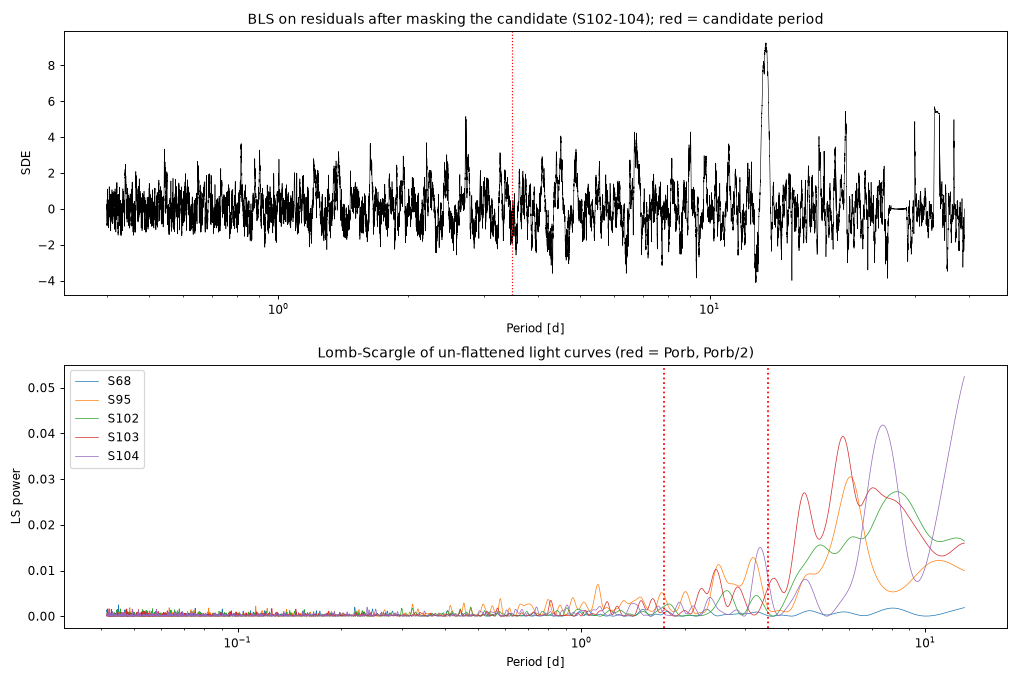
With the transits masked, a second search finds no other periodic dip. The star shows no brightness variation at the orbital period or at half of it.
A first pass flagged a 13.5-day signal. It consists of two events at the very start of data segments, where the pipeline light curve has ramps; with one day trimmed next to each gap, nothing remains above a detection statistic of 6. The official sector 68 light curve is flat to about 200 ppm.
The star has no entry in SIMBAD and is not a TESS Object of Interest. No variable-star or eclipsing-binary catalogue checked lists it. Gaia finds no orbital solution and no double image, but its astrometric quality number (RUWE) is 1.27, slightly above the value typical of single stars.
Catalogue
Search radius
Result
ExoFOP-TESS (TOIs and community candidates)
by TIC ID
No TOI, no CTOI
SIMBAD
10″
No object
AAVSO Variable Star Index
10″
No match
Gaia DR3 variability classes and eclipsing binaries
3″
No match
ASAS-SN variable stars
10″
No match
TESS eclipsing binaries (Prša et al. 2022)
10″
No match
Washington Double Star catalogue
10″
No match
RAVE DR6 and GALAH DR3 spectroscopy
3″
No spectra
Gaia DR3 non-single-star tables
by source ID
No solution
Gaia DR3 radial velocity
by source ID
−1.65 ± 1.12 km/s from 34 visits; weak constraint
A search of every VizieR catalogue at once failed with server errors, so only the catalogues listed were checked.
The false-positive probability is about 6% (median 0.057 on both light curves). The probability that a known neighbouring star is responsible is 0.
Statistical validation needs a false-positive probability below 1.5%. This candidate falls in the "likely planet" class. All of the remaining false-positive weight sits in scenarios with an unseen companion star bound to the target, which high-resolution imaging would test. TRICERATOPS does not model brown dwarfs.
Scenario probabilities
Mean of six runs of 10 million samples each on my own photometry. The pipeline light curve gives the same ranking.
Run-to-run spread
Each dot is one run. Runs with 1 million samples scattered from 0.005 to 0.47 and were discarded as not converged; they are in the data file.
Two independent reductions were fitted with a circular orbit and the stellar density left free. The own-photometry column is preferred because the QLP pipeline light curves run about 10% shallow.
Candidate
BTJD = BJDTDB − 2457000. Derived: orbital distance about 0.047 au; equilibrium temperature about 1420–1460 K for zero albedo. Radius assumes a stellar radius of 1.21 ± 0.06 R☉.
No mass. There are no spectra, so a brown dwarf or a star at the very bottom of the main sequence is not excluded.
No high-resolution imaging. A close companion star cannot be ruled out, and Gaia's RUWE of 1.27 is mildly elevated.
One band only. All photometry is from TESS. There is no ground-based or multi-colour transit.
QLP small-aperture anomaly. One pipeline product gives a much shallower, sector-dependent depth (E7). Direct photometry does not reproduce it, but the cause was not confirmed.
Sector 102 centroid. The offset there is 1.9σ (E4).
Sector 1 has no data. In 2018 the star fell in the gap between two detectors, so the baseline starts in 2023.
Sector 105 time stamps. They use the detector-centre barycentric correction and can be off by up to 1.5 minutes.
Catalogue search is partial. The all-catalogue VizieR query failed (E14).
Not peer reviewed. This is an independent analysis of public data.
Follow-up that would settle it
Two or three spectra near the orbit's quarter phases. A brown dwarf or small star would show several km/s; a planet about 126 m/s per Jupiter mass.
High-resolution imaging (speckle or adaptive optics) to look for close companions. This would also lower the false-positive probability.
A ground-based transit in a second colour. The event is 1% deep and lasts 2.1 hours.
Registration as a community candidate (CTOI) on ExoFOP so follow-up groups can pick it up.
Next transits
Mid-transit times from T0 = BJDTDB 2461156.74624 ± 0.00039 and P = 3.481584 ± 0.000003 d. The UTC column ignores the light-travel correction and can be off by up to 8 minutes; use the BJD column for scheduling.
Every file
All data products, logs, figures and scripts behind this page. Every row is a direct link.
Original data, not stored here
The pixel data are too large to host on this page. These links return exactly the files used.